© Garden-shower.eu 2026
All Rights Reserved.
All Rights Reserved.


When choosing a stainless steel outdoor shower, the material grade plays an important role in how well the shower withstands weather conditions and salt exposure. In this guide, we explain the differences between 304 and 316 stainless steel, why stainless steel can still rust, and which grade to choose for your garden or holiday home.
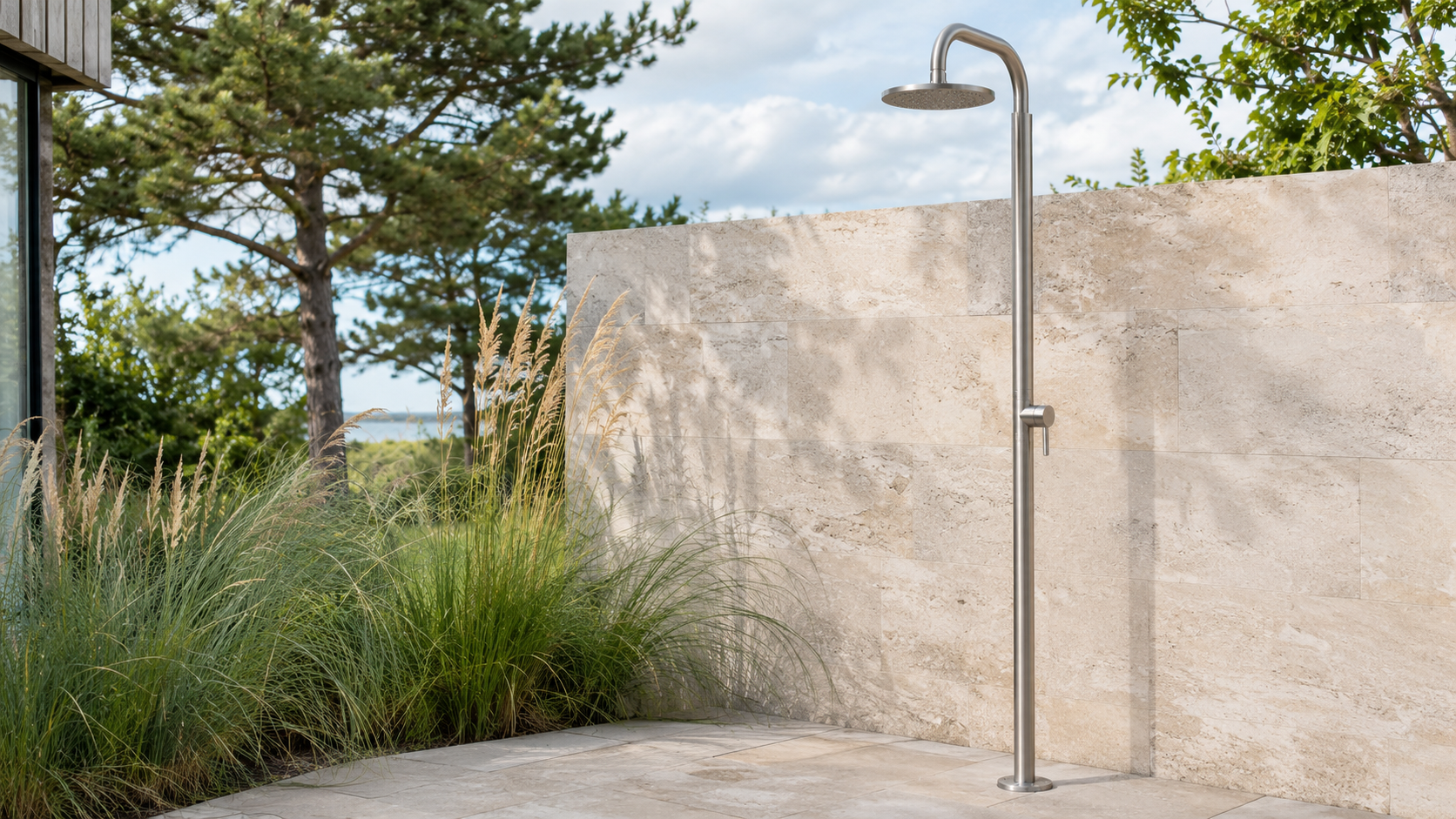
Stainless steel is a popular material for outdoor showers. It combines an elegant appearance with high strength and good durability. However, not all stainless steel grades offer the same resistance to rust and corrosion.
Two of the most commonly used grades are AISI 304 and AISI 316. They look similar and can have exactly the same surface finish, but there are important differences in their chemical composition and corrosion resistance.
These differences become particularly important when an outdoor shower is installed near the coast, where salt from the sea can affect the steel surface.
The main difference is that 316 stainless steel contains molybdenum. This alloying element improves the steel's corrosion resistance, particularly when exposed to chlorides, which are found in seawater.
A durable and widely used stainless steel grade suitable for normal outdoor environments without significant salt exposure.
A more corrosion-resistant grade particularly suited to demanding outdoor environments and locations near the sea.
A good choice when the shower is installed in a normal garden without significant exposure to sea salt.
The better choice of these two grades for an outdoor shower at a holiday home or property close to the sea.
Yes. Despite its name, stainless steel is not completely immune to rust and corrosion.
Stainless steel contains chromium, which reacts with oxygen to form an extremely thin protective layer on its surface. This is known as the passive layer.
The passive layer is responsible for stainless steel's normally high corrosion resistance. Under ordinary conditions, it can also reform if the surface is damaged.
However, heavy salt exposure, aggressive chemicals or other challenging conditions can locally break down this protection. Rust spots, discolouration or actual corrosion may then occur.
Chromium forms the thin passive layer that protects stainless steel against corrosion.
Nickel contributes to the structure and material properties of the steel.
Molybdenum improves resistance to localised corrosion caused by chlorides and is an important advantage of 316.
Seawater contains salt that can travel through the air in tiny droplets and particles. When these settle on an outdoor shower, salt can accumulate on the surface.
Over time, salt and moisture can create conditions that affect the steel's protective passive layer. This can cause localised corrosion, especially when the surface is not regularly cleaned or rinsed with fresh water.
Here, 316 has an important advantage: its molybdenum content increases resistance to chloride-related corrosion.
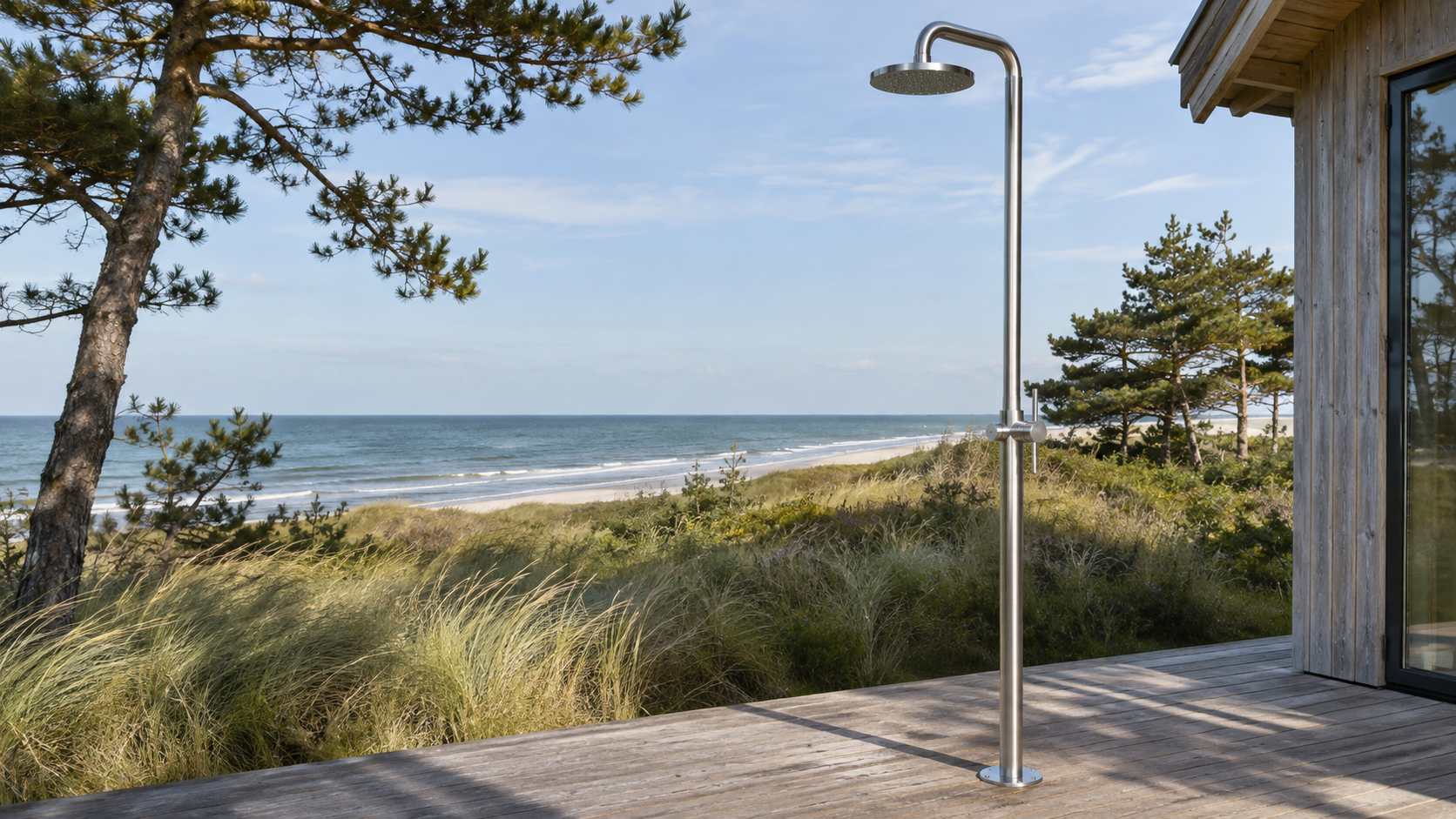
There is no universal distance beyond which sea salt exposure disappears. The risk depends on factors such as wind direction, wave activity, humidity and how sheltered the shower's location is.
A shower directly exposed to the sea may experience considerably more salt exposure than one protected by buildings or vegetation.
Along coastlines with strong winds and heavy wave activity, salt can also travel several kilometres inland.
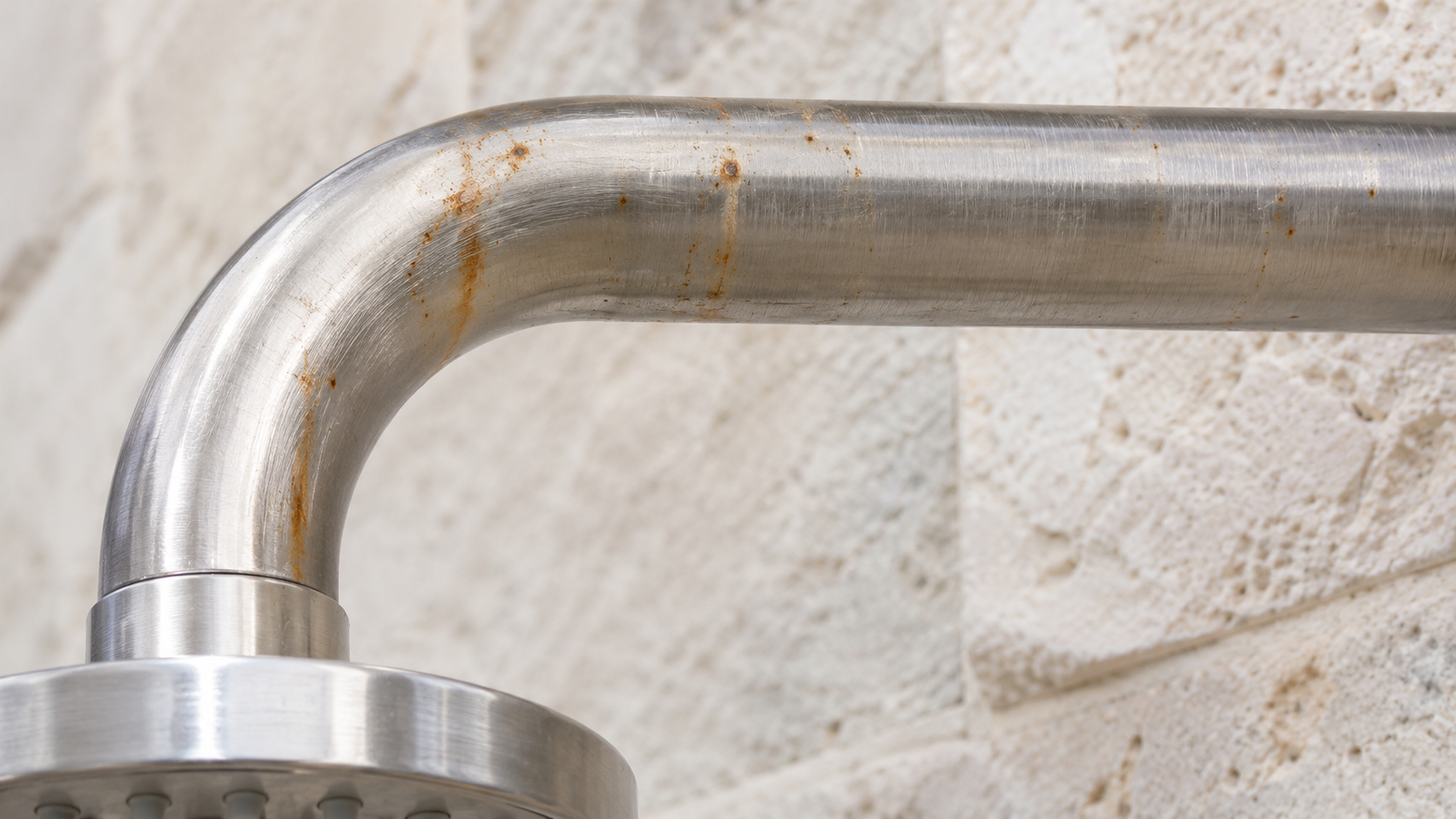
Brown or reddish-brown spots on stainless steel may indicate superficial corrosion or deposits of foreign iron particles.
In coastal environments, a phenomenon known as tea stainingcan occur. This describes brownish discolouration that may develop on the surface after prolonged exposure to salt and moisture.
Tea staining can occur on both 304 and 316 stainless steel, but 304 is generally more susceptible under the same conditions.
Brownish stains can sometimes be removed through appropriate cleaning with products suitable for stainless steel.
Small depressions or holes in the surface may indicate more serious localised corrosion.
Both grades are used in a wide range of quality products. The difference is especially important when steel is exposed to salt and other corrosive conditions.
| Property | AISI 304 | AISI 316 |
|---|---|---|
| Corrosion resistance | Good | Higher |
| Resistance to salt | Limited | Significantly better |
| Molybdenum | No intentional addition | Typically 2–3% |
| Ordinary gardens | Suitable | Suitable |
| Coastal locations | Generally not recommended | Recommended over 304 |
| Maintenance | Regular cleaning | Regular cleaning |
| Price | Generally lower | Generally higher |
The stainless steel grade alone does not determine a product's durability. Surface treatment, construction, location and maintenance also matter.
The right choice mainly depends on where your outdoor shower will be installed and the conditions it will be exposed to.
For an ordinary garden without significant salt exposure, 304 stainless steel can be an excellent choice.
We recommend 316 stainless steel because of its higher resistance to salt.
Choose at least 316 and consider whether local conditions require additional protection or a higher stainless steel grade.
Both 304 and 316 stainless steel require regular maintenance to preserve their appearance. This is particularly important for outdoor showers exposed to salt, moisture and dirt.
Use a soft cloth, water and, if needed, a mild detergent. Rinse afterwards with clean water.
In coastal areas, rinse the shower with fresh water as needed to reduce salt accumulation.
Avoid chlorine-containing cleaning products, hydrochloric acid and ordinary steel wool, which can damage or contaminate the surface.
316 has higher corrosion resistance, especially in environments containing salt and chlorides. For coastal installations, 316 is generally the better choice of the two grades.
Yes. 304 can develop rust spots, discolouration and localised corrosion, particularly after prolonged exposure to salt and moisture.
Yes. 316 is more corrosion-resistant than 304, but it is not completely immune under all conditions. Heavy salt exposure and insufficient maintenance can still cause corrosion.
316L is a variation of 316 with a lower maximum carbon content. This is particularly beneficial during welding because it reduces the risk of certain forms of corrosion around welds.
Usually not. Both grades can have the same colour, shine and surface finish. The difference lies in their chemical composition.
304 stainless steel is a good, durable choice for ordinary gardens where salt exposure is limited.
If your outdoor shower will be installed near the sea, we generally recommend 316 stainless steel. Its higher corrosion resistance makes it better suited to the more demanding conditions found in coastal environments.
At Garden-shower.eu, you will find outdoor showers in different materials and quality grades, helping you choose the right solution for your garden.
Explore our outdoor showers


